PBL 7 Viral diseases
LO: Describe the main classes of viruses causing human disease and the mechanism by which viruses cause infection
Virus classification (Yeatman, Riva and Martin, 2025)
- Groupings within species - strains or serotypes, result of mutations
- At higher level, viruses are grouped into families
Taxonomy
- Order
- Family
- Subfamily
- Type species
- Morphology (shape of nucleocapsid)
- Genetic material
- Envelope
Baltimore classification
- Uses genome, the presence/absence of reverse transcriptase (RT) and other enzymes and the presence/absence of an envelope
- Positive/negative single stranded nucleic acids, polarity of the strand relative to mRNA
- Positive means same base sequence (U
T) as viral mRNA - Negative means complementary sequence to the + strand and viral mRNA
- Positive means same base sequence (U
- Baltimore class:
- Double-stranded DNA
HPV, Epstein-Barr, Smallpox - Single-stranded DNA (+ or -)
B19 - Double-stranded RNA
Rotavirus - Single-stranded RNA (+)
SARS-CoV-2, Poliovirus, Rubella, Hepatitis C - Single-stranded RNA (-)
Influenza, Measles, Rabies, Ebola - Single-stranded RNA (+) with RT
HIV - Double-stranded DNA with RT
Hepatitis B
Infection of host cells (Goering, 2025)
Virus particles enter the body
- Inhaled droplets
- In food or water
- Direct transfer from other infected hosts such as infected body fluids by sexual transmission or blood borne routes
- Bites from vector arthropods
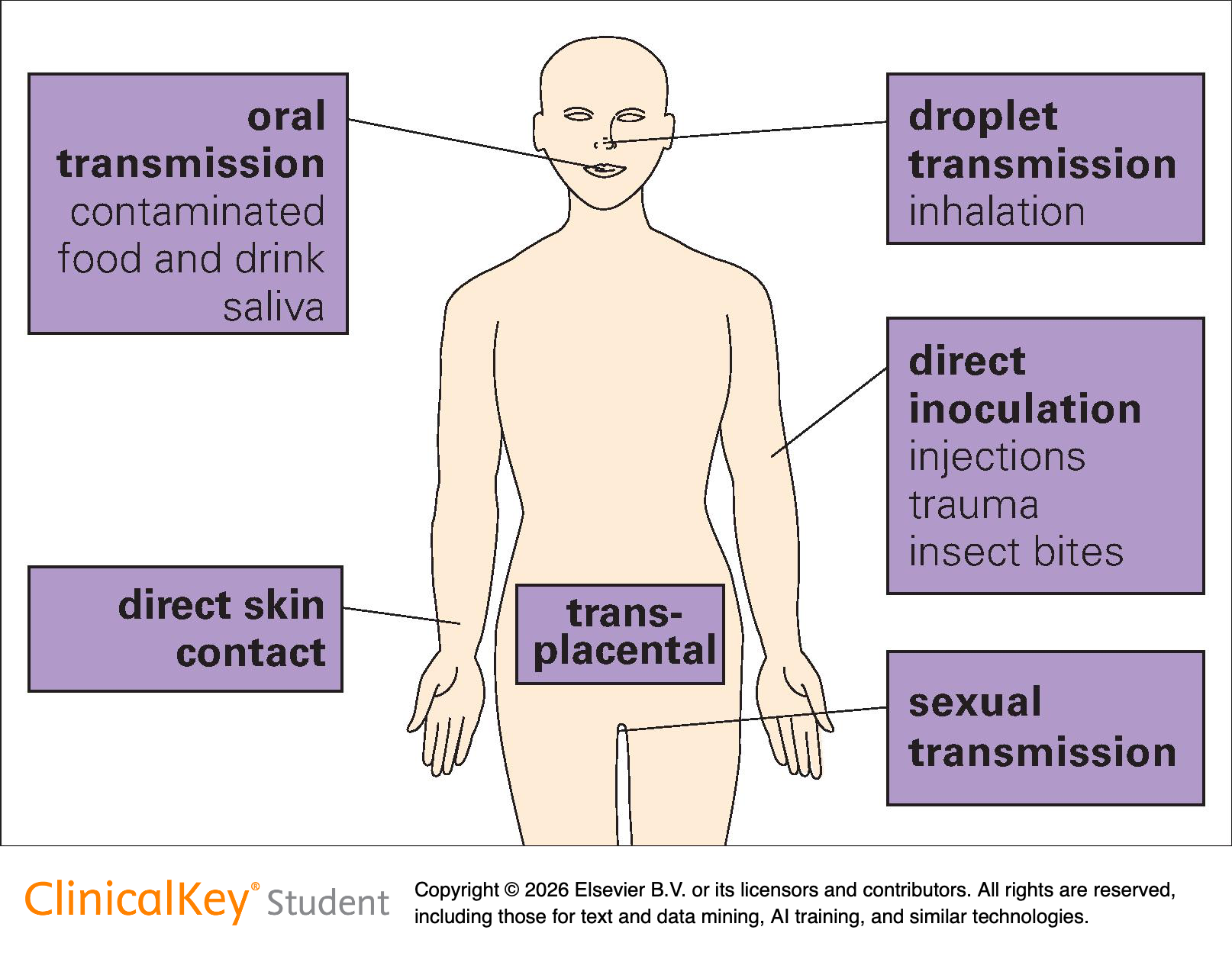
(Goering, 2025)
Viruses show host specificity
-
Usually infect only one or a restricted range of host species
-
Attachment to a host cell depends on general intermolecular forces
-
In more specific interactions - between the molecules of the nucleocapsid in unenveloped viruses or virus membrane in enveloped viruses and host cell membrane
-
Tropism - specific interaction with a particular host molecule, which acts as a receptor
HIV targets T helper cells (CD4) specifically - tropism -
After fusion of viral and host membranes/uptake into a phagosome, virus particle is carried into the cytoplasm across the plasma membrane
-
Envelope/capsid is shed and viral nucleic acid released
-
Virus is no longer infective: this eclipse phase persists until new complete virus particles reform after replication
Replication
- Viruses contain either DNA or RNA
- These can be single or double strands, in linear (DNA/RNA) or circular (DNA)
- Viral genome may be carried on a single molecule of nucleic acid or on several molecules
- DNA-based virus: mRNA formed using host's own RNA polymerase to transcribe directly from viral DNA
- RNA-based virus: cannot be transcribed this way, so virus must provide its own polymerases - carried in the nucleocapsid or synthesised after infection
RNA viruses
- Produce mRNA by several routes
- dsRNA (double-stranded) viruses contain a - and + sense strand
- Positive strand is directly used as mRNA
- ssRNA (single-stranded):
- Positive sense configuration, use directly as mRNA
- Negative sense configuration, must be transcribed using viral polymerase into + sense strand and can be directly used as mRNA
- Retroviruses, + sense ssRNA made into - sense ssDNA, using viral reverse transcriptase. Formation of dsDNA, enters nucleus and integrates into host genome and then transcribed by host polymerase into mRNA

Translation
- Viral mRNA is translated using host ribosomes to synthesise viral proteins
- Viral mRNA, usually monocistronic (produces one polypeptide), has a single coding region and uses different mechanisms to favour its translation over host mRNA and allowing viral products to be synthesised preferentially
- Early phase, proteins produced are enzymes that allow subsequent replication of viral nucleic acids
- Later phase, the proteins necessary for capsid formation are produced
- In single nucleic acid viruses, translation produces a large multifunctional protein (polyprotein) which is cleaved enzymatically to produce a number of distinct proteins
- In viruses with a number of nucleic acids, several mRNAs produced each translates into separate proteins
- Proteins may be glycosylated using host enzymes
Replication of nucleic acid
- Virus must replicate nucleic acid to provide genetic material to be packaged into new capsids, results in new virions - uses viral RNA polymerases
- Positive sense ssRNA: polymerase translated from viral mRNA produces - sense RNA from + template, transcribed repeatedly into more positive strands and leads to production of very large numbers of + strands
- Negative sense ssRNA: transcription produces + sense RNA strands, some are polymerases which transcribes + to - sense RNA
- RNA replication can occur in host cell cytoplasm or within the nucleus
- dsRNA: + sense RNA strands produced and act as templates for synthesis of new - sense strands and packaged with + as dsRNA
Assembly and release
- Involves the association of replicated nucleic acid with synthesised capsids to form a new nucleocapsid
- In cytoplasm or nucleus of host cell
- Enveloped viruses: envelope proteins and glycoproteins inserted into areas of host cell membrane and the nucleocapsid associates specifically with the membrane in these areas, via the glycoproteins
- Host cell enzymes may cleave the initial large envelope proteins - necessary for viruses to be infectious
- Insertion of viral molecules into host cell membrane results in host cell becoming antigenetically different
- Expression of viral antigens is a major factor in the development of antiviral immune responses
Outcome of viral infection
- Can cause cell lysis, become chronic or lie latent
- Lytic infection - cycle of replication
- Chronic - cell remains alive and continues to release virus particles
- Chronic infection: infected person may act as a symptomless carrier of the virus
- Latent - virus remains quiescent, genetic material may exist in host cell cytoplasm or be incorporated into the genome
- Replication does not take place until some signal triggers a release from latency
Quiz
Start of round SFX
Do not prescribe antibiotics
Reason: fever on the low end and infection only for 5 days, should wait as bacterial infections last longer than 7-10 days
Antibiotics may not help and risk of antibiotic resistance (antibiotic stewardship)
Correct answer: continue with rolled number
Incorrect answer: go back 2 spaces
No, norovirus is not officially a notifiable disease
Correct answer: continue with rolled number
Incorrect answer: go back 2 spaces
Any 4 of:
Reference list
- Yeatman, N., Riva, A. and Martin, J. (2025) ‘Infection, immunology and pathology’, in D. Syndercombe Court MIBiol, CBiol, FIBMS, CSci, DmedT, FCSFS, PhD, A. Kadri BSc, MBBS, MSc, MFPH, and P. Xiu MA (Cantab), MB BChir, MRCP, MRCGP, MScClinEd, FHEA, MAcadMEd, RCPathME (eds) Medical Sciences, pp. 237–315. Available at: https://doi.org/10.1016/B978-0-7020-8239-9.00015-7.
- Goering, R. (2025) ‘The viruses’, in R. Goering (ed.) Mims’ Medical Microbiology and Immunology, pp. 27–34. Available at: https://doi.org/10.1016/B978-0-323-93725-2.00003-0.