PBL 6 Inflammatory arthritis
LO: Discuss the basic epidemiology, pathophysiology, presentation, investigation, management and prognosis of reactive arthritis
Reactive arthritis
- Triad of arthritis, urethritis and conjunctivitis
Epidemiology (1)
- Complicates 0.8% of urethral infections in males and 0.2% of cases of dysentery
- Males > females (15:1)
- Usual age of onset is 20-40 years
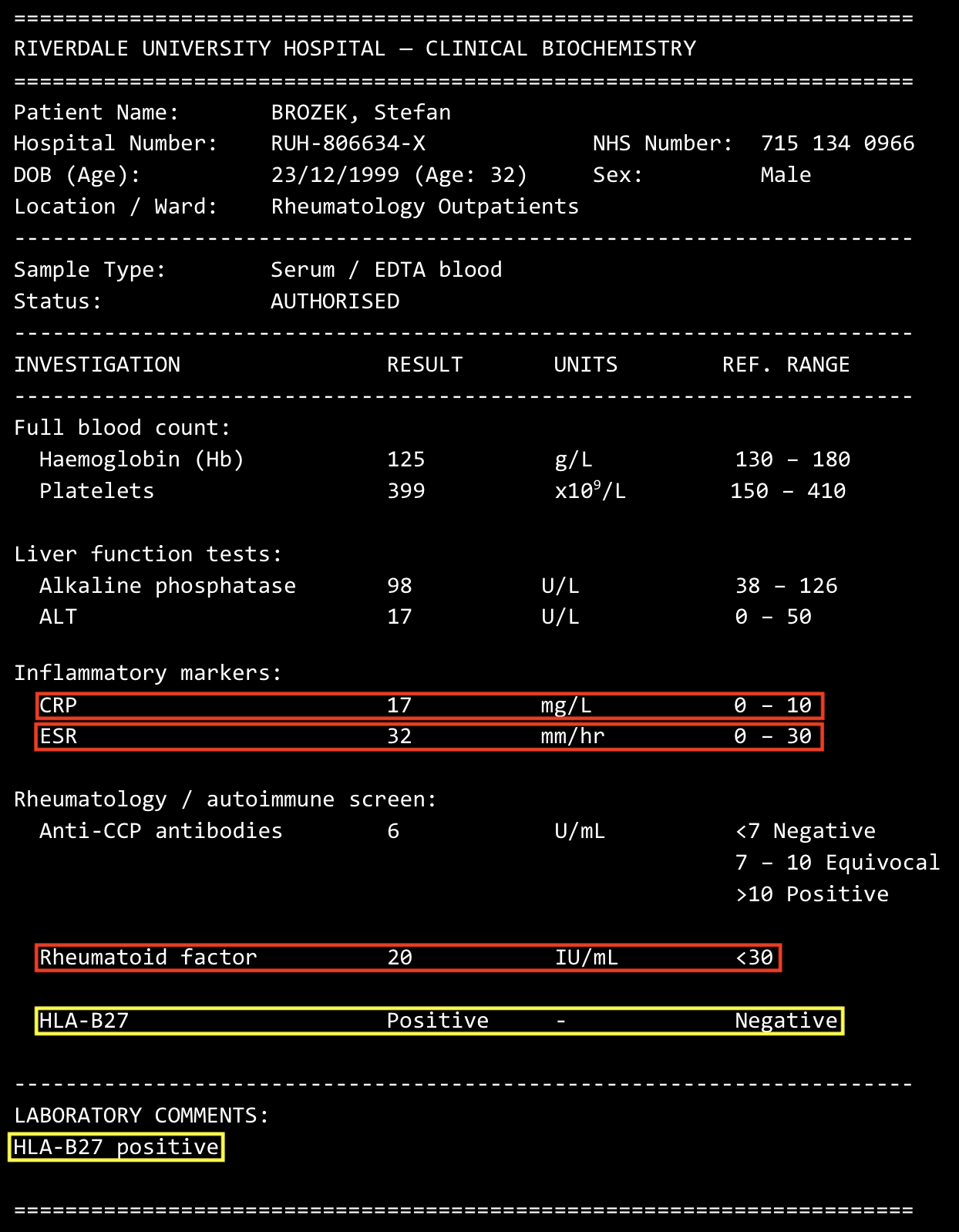
- More than 80% are HLA-B27 positive

Stefan Broski
Pathophysiology (1)
- Mechanism between host and pathogen and disease unknown but probably autoimmune - triggered by a prior genitourinary/gastrointestinal infection
- Strong association of reactive arthritis with HLA-B27
- HLA-B27 on antigen presenting cells present microbial peptides that may mimic certain self-peptides to CG8 cytotoxic T cells
- Genitourinary - follows nonspecific (nongonococcal) urethritis or, less commonly, cystitis (bladder inflammation) or prostatitis
- Intestinal or postdysenteric type - follows dysentery or nonspecific diarrhoea, after 10 to 30 days after intestinal manifestations
- Infection is usually with Salmonella, Shigella, Yersinia, Campylobacter, Chlamydia, Neisseria gonorrhoeae

Presentation (1)
- Asymmetric arthritis - affecting knee or ankle and developing within weeks of the infectious episode
- Clinically and histologically, arthritis resembles rheumatoid arthritis with chronic inflammatory synovitis
- Dysuria and penile (or vaginal) discharge
- Conjunctivitis (in 30% of cases)

Investigation (3)
- Elevated ESR and/or CRP
- Polymorphonuclear leukocytosis
- Thrombocytosis and anaemia of chronic disease
- Negative rheumatoid factor
- Pyuria, microhematuria +/- bacteria in urinalysis
- Moderate leukocytes (2,000-50,000 cells/mm3), negative Gram stain and no crystals in synovial fluid
- Decreased synovial fluid viscosity, normal glucose level and increased protein
Management (2)
- Main goal to eliminate underlying infective causes if still present
- Treatment is symptomatic with analgesia (NSAID) and resting of the affected joints
- Joint aspiration - exclude septic arthritis and aid with pain management
- Intraarticular/systemic steroids can be used in the acute phase
- Immunosuppressants, steroids or DMARDs (Disease-modifying antirheumatic drugs) may be needed in patients with severe nonresponsive cases
- Disease is usually self-limiting and settles within 3 to 12 months
Prognosis (1)
- First attack typically resolves spontaneously within 6 months
- 50% of patients relapse and some have continued relapsing chronic arthritis, causing disability but seldom deformity
- Minority of cases: development of severe spondylitis and features similar to those of ankylosing spondylitis
Quiz
https://wordsalad.owen-chu.tech/
Accompanying questions
Arthritis: What are the other 2 inflammations linked to reactive arthritis?
Urethritis (urethra)
Conjunctivitis (conjunctiva/eyes)
Autoimmune: Why can reactive arthritis be considered to be autoimmune?
There is a strong association with HLA-B27, which is on antigen presenting cells and can undergo molecular mimicry (Microbial peptides can mimic self-peptides)
Salmonella: How is this a risk factor in Stefan's case?
Works on a chicken farm so may be exposed to Salmonella bacteria from the chicken
Synovial: What features in the synovial fluid could suggest that there is reactive arthritis?
Elevated CRP (ESR is in blood sample)
Negative rheumatoid factor
Moderate leukocytes
No crystals
Decreased viscosity
Increased protein
Reference
- McKinney Olivia BA MBBS FRCPath,Woodman Isabel MA (Cantab) MSc MBBS FRCPath, 16 - Pathology of the musculoskeletal system, Crash Course Pathology (Fifth Edition), edited by McKinney Olivia BA MBBS FRCPath,Woodman Isabel MA (Cantab) MSc MBBS FRCPath, 2019, Pages 283-304, ISBN 978-0-7020-7354-0, http://dx.doi.org/10.1016/B978-0-7020-7354-0.00016-3. (https://www.clinicalkey.com/student/content/book/3-s2.0-B9780702073540000163)
- Eiben Paola MBBS BSc FRCA,Eiben Inez MBBS BSc MRCS,Hever Pennylouise MBBS BS (Hons) MRCS,Giles Megan MBBS MRCP (UK) PGCert (MedEd), 35 - Musculoskeletal system, Crash Course General Medicine (Sixth Edition), edited by Eiben Paola MBBS BSc FRCA,Eiben Inez MBBS BSc MRCS,Hever Pennylouise MBBS BS (Hons) MRCS,Giles Megan MBBS MRCP (UK) PGCert (MedEd), 2025, Pages 373-387, ISBN 978-0-443-11538-7, http://dx.doi.org/10.1016/B978-0-443-11538-7.00035-5. (https://www.clinicalkey.com/student/content/book/3-s2.0-B9780443115387000355)
- Alonso Itziar Quinzaños MD, Chapter 36 - Reactive Arthritis, Rheumatology Secrets (Fourth Edition), edited by West Sterling G. MD MACP MACR,Kolfenbach Jason MD FACR, 2020, Pages 298-307, ISBN 978-0-323-64186-9, http://dx.doi.org/10.1016/B978-0-323-64186-9.00036-4. (https://www.clinicalkey.com/student/content/book/3-s2.0-B9780323641869000364)