Anatomy of lower limb
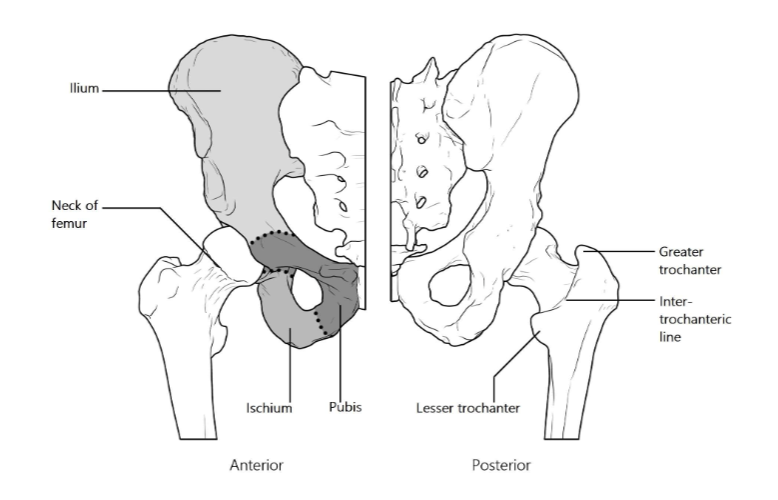
Hip (innominate) bone
- Fusion of 3 separate bones: ilium, ischium, pubis
- Socket that receives femur to form hip joint is called the acetabulum (acetabular fossa)
- Hole formed by the union between pubis and ischium is called the obturator foramen
Articulations
- Pelvis - 2 hip bones that articulate anteriorly via cartilaginous joint and the sacrum posteriorly via a synovial joint
- Sacroiliac joint and pubic symphysis are very limited so provide a stable structure for weight transfer and shock absorption
Bony features
- Iliac crest - top of ilium, curved
- Iliac fossa - depression on ilium
- Anterior superior/inferior iliac spine - bumps on ilium
- Pubic tubercle - sticky out bit on pubis
- Greater/lesser sciatic notch - curve on hip bone
- Ischial spine - bump on ischium
Hip joint
- Very stable joint supported by ligaments
- Thick and strong ligaments - limit movement
Femur
- Longest bone in body
- Articulates proximally with hip (hip joint) and distally with tibia (knee joint)
- Rounded condyles form a hinge joint with tibia
Proximal tibia
- Tibial plateau receives femoral condyles (epicondyles, epi - on top)
- Intercondylar ridge - attachment for cruciate ligaments
- Tibial tuberosity provides attachment for muscles
Knee joint
- Collateral ligaments prevent femur from tipping side to side on tibia
- Cruciate ligaments prevent femur from sliding forwards or backwards on tibia
- Rotation can occur
Distal leg
- Tibia is weight bearing
- Fibular - muscle and ligament attachment
- Distally both have bony projections called malleoli that form the receptacle for the talus in the talocrural joint
- Malleoli - provides ligament attachment
Talocrural joint
- Collaterals - prevent leg bones from tipping side to side
- Only flexion (plantar flexion) and extension (dorsiflexion) can occur
Subtalar joint
- Talus sits over calcaneous
- Rocks side to side (saddle joint)