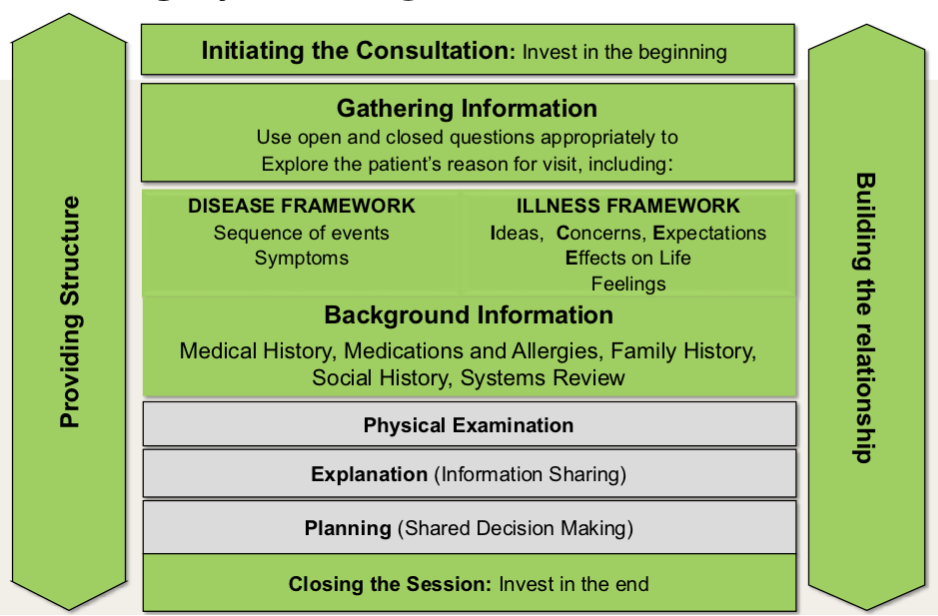
Gathering information in a patient-centred consultation 2 LO: Demonstrate effective verbal and non-verbal communication behaviour that builds the relationship from the opening of a consultation Negotiation of agenda Involve patient Collaborative partnership between patient and doctor Doctor helps organise consultation and avoid incomplete information gathering Structure is clear and patient has more responsibility and involvement in the consultation Calgary Cambridge guide
Explore reason for the visit to discover both disease and illness perspective Gather accurate and complete information Ensure patient feels listened to Build supportive relationship with patient Disease/illness model flowchart LR
subgraph Disease
Symptoms
A[Medical history]
B[Medication history]
Allergies
C[Social history]
D[Family history]
Lifestyle
E[Systems review]
end
subgraph Illness
Ideas
Concerns
Expectations
F[Effects on life]
Feelings
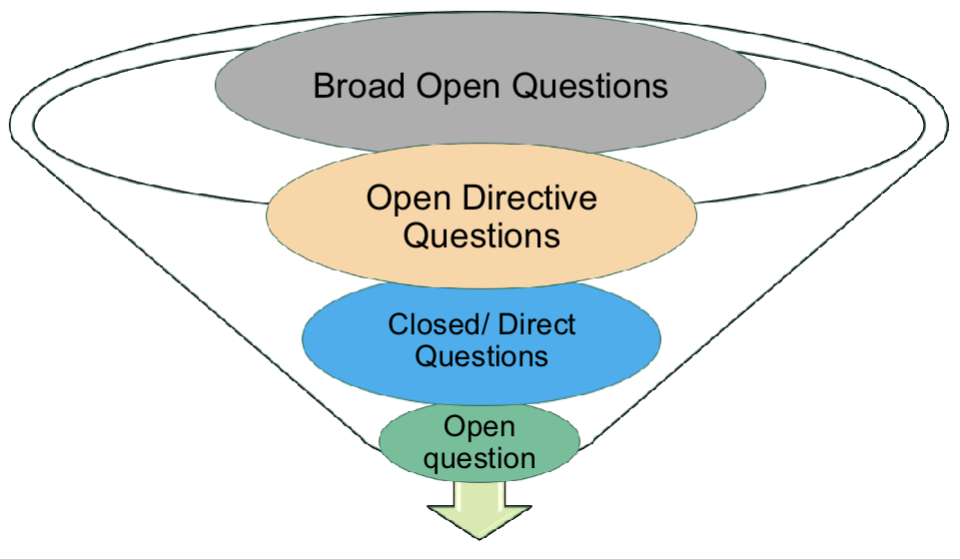
end Doctors gather information by integrating the two frameworks Open-to-closed cone style of question
Start with open questions Encourages patient to tell their story Prevents 'shot in the dark' closed questioning Time and space to listen and think Helps explore both disease and illness frameworks Pattern of patient partnership Open questions Ideas Concerns Expectations Effects on life Feelings Closed questions Specific areas not emerged from patient's account Explore symptoms in detail (SOCRATES) Gather background information SOCRATES Question S iteCan you point to where it hurts? O nsetWhen did it start? C haracterCan you describe what sort of pain it is? R adiationDoes the pain go anywhere else? A ssociated symptomsHave you noticed anything else? T imingHow long does it last for? E xacerbating/relieving factorsDoes anything make it better/worse? S everityOn a scale of 1-10, how bad is it? 10 is worst pain imaginable
Systems review "Are you otherwise well?" If no or hesitant "Do you have any problems with sleep, appetite, weight, temperature, energy, mood" SAWTEM: Sleep, Appetite, Weight, Temperature, Energy, Mood LO: Demonstrate a patient-centred approach, including behaviours that show respect for and interest in the patient Multiple questions Block information gathering More than one question asked simultaneously Confusion L LO: Demonstrate active listening and observation skills