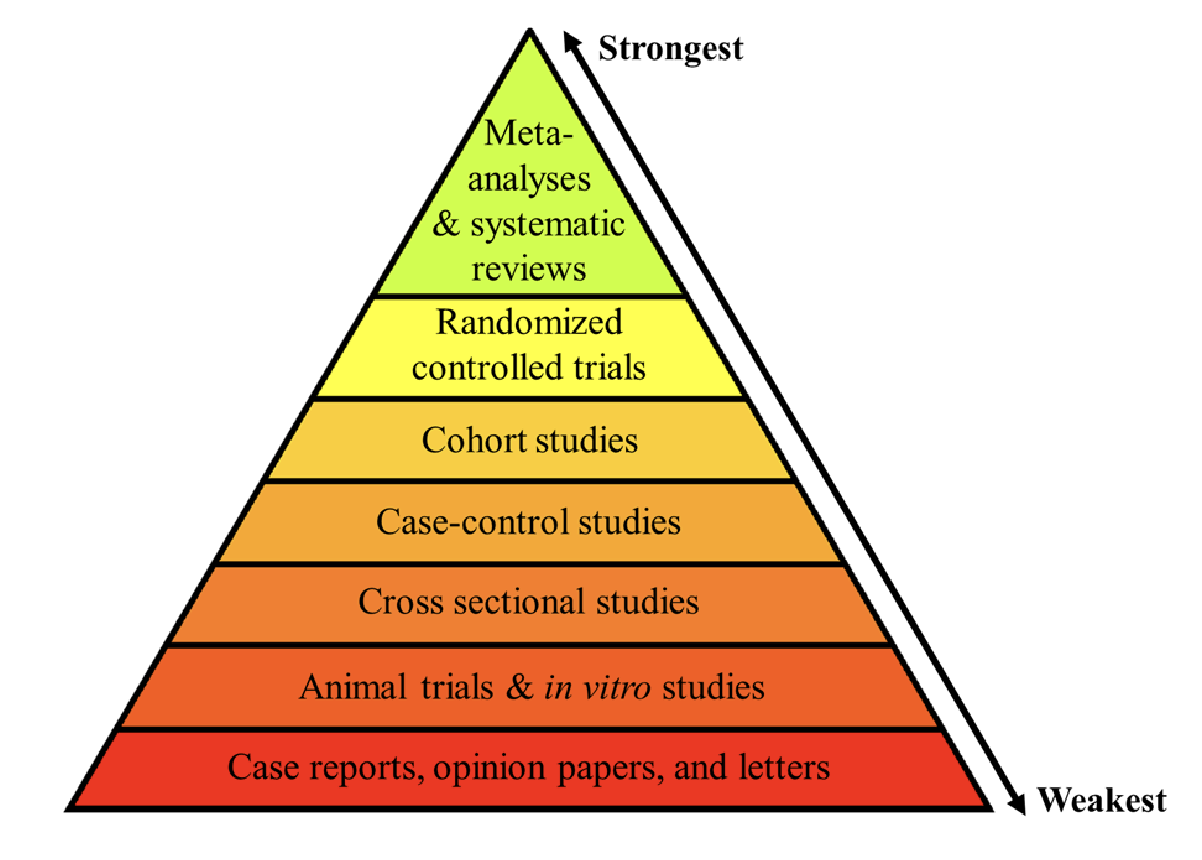
LO: Describe and compare the design, strengths, limitations and appropriate use of common research methodologies (RCTs, quasi-experimental studies, cohort studies, case-control studies, systematic reviews and meta-analyses) and explain how these relate to the hierarchy of evidence.
Interventional studies
Participants allocated to receive one or more interventions (new drugs, device or behaviour change) to compare outcomes
Randomised controlled trials (RCTs) - main interventional study design
Randomised controlled studies (RCTs)
Randomly allocate to groups - control and comparator group
Interested in a particular group
CONSENT!!!!!
PICO
Useful for summarising studies
Population
Sample type
Intervention
Alternative hypothesis H1
Control
Null hypothesis H0
Outcome
Change/no change
Experiments
Evidence of causation
Confounder - variable that influences both dependent (exposure) and independent variable (outcome), causes a spurious relationship
flowchart TD
	Weather --> A[Ice cream sales]
	Weather --> B[Homicide rates]
	A <-.-> |Does not cause|B
flowchart TD
	A[Study population] --> B{Selection criteria applied}
	B --> C[Potential participants]
	B --> D[Non-participants]
	C --> E[Invitation to participate]
	E --Volunteer bias--> Participants
	E --> D
	Participants --Selection bias--> Randomisation
	Randomisation --> Treatment
	Randomisation --> Control
	Treatment --Performance bias--> Outcome/s
	Control --Lost to follow up bias--> Outcome/s
	Outcome/s --Detection bias--> F[Published data]

	F --Reporting bias--> Public
Internal validity
Strength of evidence for causality - degree to which results are attributable to the intervention than other factors
Strong in RCTs with robust randomisation and blinding
RCTs good for measuring efficacy
RCT weaknesses
Expensive (t and £)
Short follow-ups
Not always feasible
Not always ethical
Generalisability/external validity
External validity
Degree to which study results can be applied to wider populations and settings
RCTs often have lower external validity
Selection criteria lead to particular participant types recruited