Statistical significance
LO: Interpret basic statistical concepts such as confidence intervals, p-values, hypothesis testing and relationship to clinical significance
Statistical inference
- Use of sample data to draw conclusions about the wider population (while accounting for uncertainty)
- Sampling variation (random error): natural variation in results that occurs because a study examines a sample (subset) of a population rather than the whole population
Confidence intervals
- Statistical theory used to derive an interval - the confidence interval (CI) which tells us about the precision/uncertainty around the estimate
- Narrow confidence interval - more precise/less uncertain
- Wider confidence intercal - less precise/more uncertain
- Provides a range of plausible values for the population parameter
- % confidence interval is a range of values around a particular statistic expected to contain the true population value of that statistic
Factors affecting confidence interval width
- Higher degree confidence interval - wider range
- Smaller sample - greater uncertainty so wider range
- Sample variation - greater outcome variation increases uncertainty
Null values
- Value that represents 'no effect' or 'no difference'
- Difference in means - 0
- Risk ratio or odds ratio - 1
Hypothesis testing
- Null hypothesis (H0): no difference/effect in the population
- Alternate hypothesis (H1): a difference/effect in the population
- Assume H0 as a baseline
- How compatible are the observed data with H0
- Quantify with a p-value

P-values
- P-value: probability of obtaining a result at least as extreme as that observed
- Probability - values between 0 and 1
- Smaller the p-value the less compatible the observed data aligns with the null hypothesis
- Absence of evidence
evidence of absence - Lack of statistically significant evidence does not (robustly) show there is no effect
- Hard to prove something does not impact negatively
Statistical significance
- For a pre-specified threshold (
) a result is said to be 'statistically significant' if the p-value is smaller than threshold - Pre-specification avoids arbitrary selection to get a significant result
- Threshold is often 0.05, no science behind this just vibes
- (1-
) x 100% confidence interval and p-values intuitively relate to statistical significance
Clinical significance
- Statistical significance: is the result sufficiently incompatible with H0
- Clinical significance: is the size of the effect large enough to make a meaningful difference to patients or clinical practice
Managing error rates
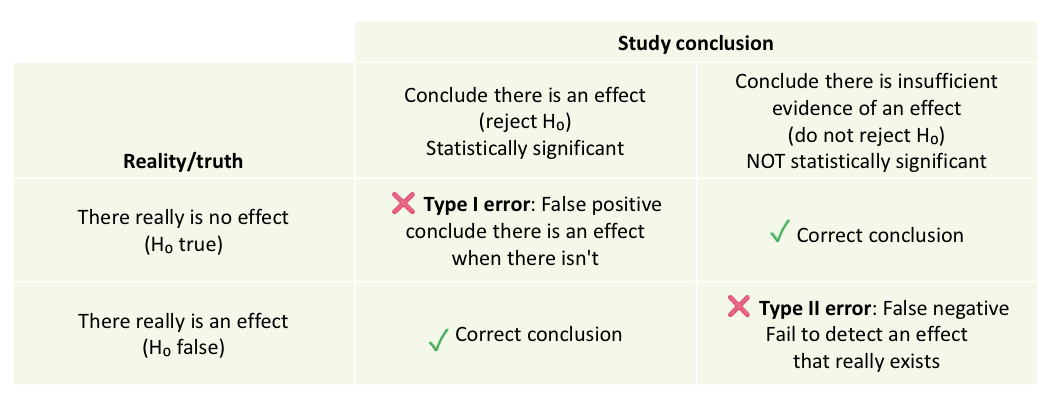
- Probability of Type I error set by
=0.05 - if H0 true, 5% chance of incorrectly rejecting it
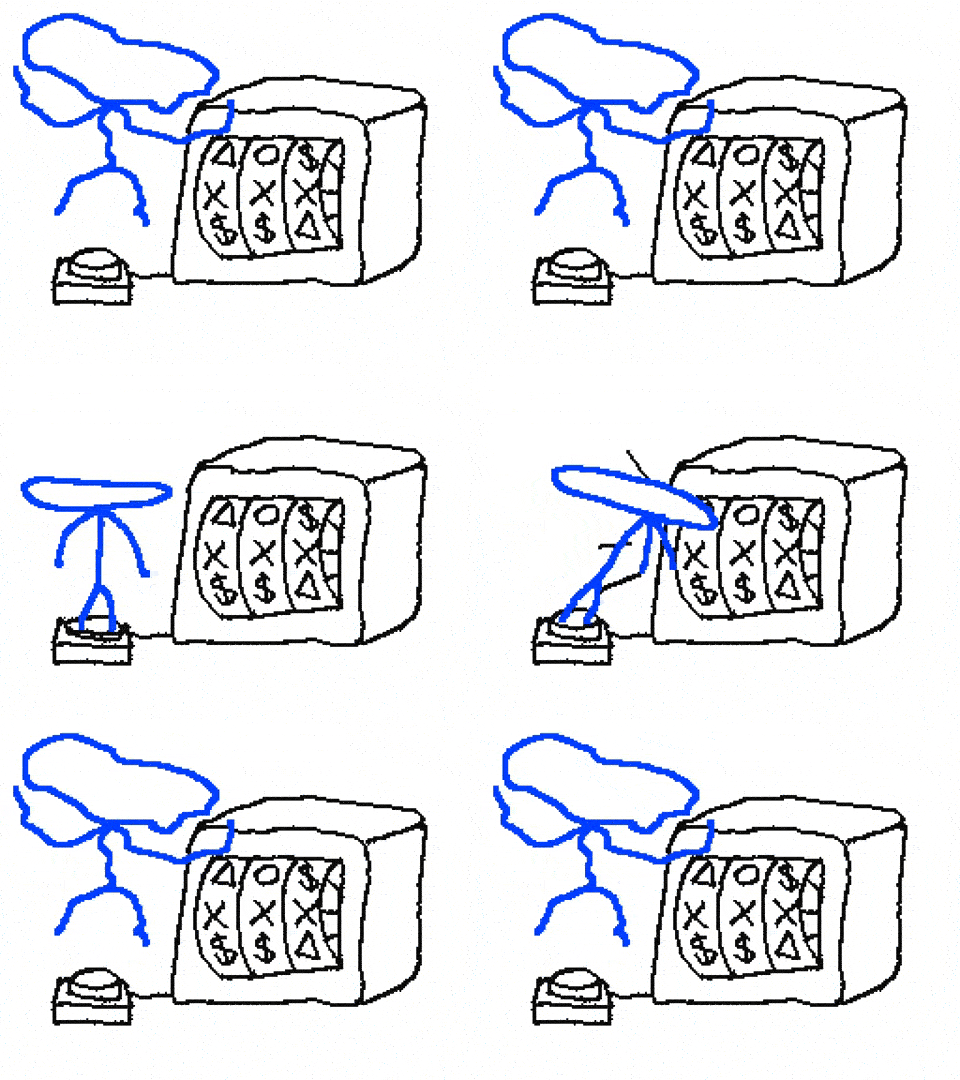
- More tests performed - greater chance of at least one false-positive result
- Probability of Type II error often denoted by
- Often talk about power = 1 -
- Higher power means a greater chance of detecting a true effect if there is one
- Often talk about power = 1 -