Polyarticular pain
LO: Discuss the presentation, initial investigation, key differential diagnosis and initial management of polyarticular joint pain
- Polyarthritis - many joint inflammation
- Polyarthralgia - many joint pain
- More than 4 joints involved
- Oligo (2-4)
- Mono (1)
History and examination
- Most important aspect of trying to formulate investigations and management plans
- Inflammatory vs non-inflammatory
- Pain due to arthritis or arthralgia
- Distribution of joint involvement
- Extra-articular features
- Pattern of joint involvement: Migratory, Additive, Intermittent
Dermatological manifestations
- Erythema chronicum migrans - Lyme
- Erythema nodosum - sarcoid
- Psoriatic plaques - psoriatic arthritis
- Keratoderma blenorrhagicum - reactive arthritis
Causes of acute polyarthritis
| Infection | Other inflammatory |
|---|---|
| Gonococcal | Rheumatoid arthritis |
| Meningococcal | Polyarticular and systemic juvenile idiopathic arthritis |
| Lyme | Acute sarcoid arthritis |
| Acute rheumatic fever | Systemic lupus erthematosus |
| Infective endocarditis | Reactive arthritis |
| Viral | Psoriatic arthritis |
| Polyarticular gout |
Disseminated gonococcal infection
- Young, healthy adults
- 1-3% with gonorrhoea
- Migratory polyarthraldia/arthritis
- Skin rash - common but subtle
- 25% have genitourinary symptoms
- Less than 25% with positive joint cultures
- Positive blood cultures rare
- Treatment - Antibiotics (ceftriaxone)
Investigations
- Bloods
- Full blood count
- Renal function
- Liver function tests
- Inflammatory markers - ESR/CRP
- Immunology: rheumatoid factor, anti-nuclear antibody
- Uric acid, thyroid-stimulating hormone, iron studies, HLA-B27
- Radiology
- Plain x-rays
- Ultrasound and MRI
- Synovial fluid
- Consider if suspicion of bacterial joint infection of crystal arthritis
Chronic inflammatory causes
- Rheumatoid arthritis
- Spondyloarthropathies: axial spondyloarthropathy, psoriatic arthritis
- Seronegative/B27 related: above and enteropathic arthritis, reactive arthritis
- Crystal arthritis: gout, CPPD
- Connective tissue disease: SLE, scleroderma, myositis
- Vasculitis
- Sarcoid, adult onset Stills disease
Joint distribution
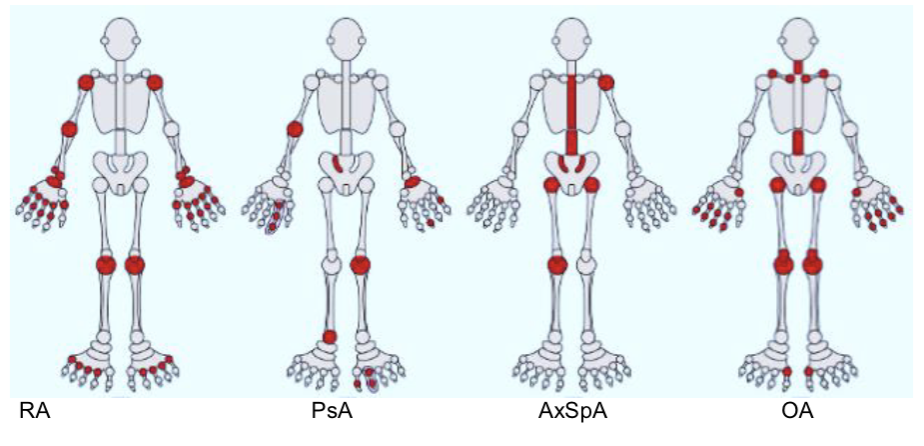
LO: Discuss the basic epidemiology, presentation, investigation, management and prognosis of Lyme disease
Lyme disease
- Tick borne - peak onset in spring and summer
- Borrelia burgdorferi
- Erythema chronicum migrans - diagnostic skin lesion occurring at site of the bite: 1-4 weeks after bite
- Disseminated infection can affect the heart, nervous system and joints
- Early localised - ECM, flue like sx
- Early disseminated - facial nerve palsies, lymphocytic meningitis, conduction abnormalities, carditis
- Late disease - neurological, arthritis
- Treatment - doxycycline if early, IV antibiotics if late
Rheumatic fever
- Causes migratory polyarthritis, usually in children
- Systemic inflammatory syndrome occurring in the setting of those with group A streptococcus
- Common cause of acquired valvular heart disease in the world
- Jones criteria - diagnosis
- 1 major = 2 minor,
=2 major - Major: carditis, arthritis, chorea, erythema marginatum, subcutaneous
- Minor: arthralgia, fever, elevated CRP/ESR, prolonged PR interval
- 1 major = 2 minor,
- Arthritis - typically migrating, tends to affect large joints of the lower limb
- Treatment - antibiotics
Common viral infections
- Majority are self limiting (resolve on their own) and do not cause permanent joint damage
- Almost any virus can cause arthralgia or a self limiting arthritis
- History including exposures and travel are important to diagnose
- Can cause autoantibodies such as rheumatoid factor and anti-nuclear antibodies
- Parvovirus B19 is common - adults feel worse than children
Tuberculosis (Poncet's disease)
- Mycobacterium tuberculosis
- Elderly, residing in endemic country, immunosuppressed patients, alcoholics and drug users are at risk
- Pulmonary or visceral TB an acute symmetrical polyarthritis can occur - presumably reactive, typically large joints
- Resolves after treatment for TB initiated
- Actual infection of the joint with TB can occur but this is typically monoarthritic